
The five warmest years in Indian weather history have occurred in the past 14 years -- the others being 2009, 2017 and 2010, in order of intensity.

'Keeping the global temperature below not just 1.5 degree Celsius, even 2 degree Celsius is beyond our reach now. Both are impossible.'

The year 2024 was the hottest year on record, with the global average temperature exceeding 1.5 degrees Celsius above pre-industrial levels for the first time, according to the European climate agency Copernicus. Every month from January to June was the warmest ever recorded, and from July to December (except August), each month was the second warmest on record. Scientists are warning that the world is entering a new climate reality, with extreme heatwaves, floods, and storms becoming more frequent and severe. The report also highlights the failure of developed nations to meet their climate finance commitments to developing countries, despite the urgency of the situation.

The Reserve Bank on Wednesday announced the increase of the UPI Lite wallet limit to Rs 5,000 and per-transaction limit to Rs 1,000, in order to encourage wider adoption of the popular instant payment system through mobile phones. A limit of Rs 500 per transaction and an overall limit of Rs 2,000 per UPI Lite wallet, is presently applicable, with the facility of auto-replenishment. Unveiling the October bi-monthly monetary policy, Reserve Bank Governor Shaktikanta Das also said the per-transaction limit in UPI123Pay will be enhanced to Rs 10,000 from the current Rs 5,000.

A cloudburst in the high altitude villages of Dharali in Uttarkashi district of Uttarakhand led to flash floods, causing damage to houses and sweeping away structures. Several people are feared buried under debris.

Heatwave conditions are expected over northwest India during the next five days, with Punjab, Haryana, Rajasthan and Delhi predicted to bear the maximum impact, the India Meteorological Department (IMD) said on Thursday.

To ensure immediate cooling of the body, the hospital has set up a first-of-its-kind heatstroke unit.

The Met office has issued a "red" warning for Delhi, Haryana, Punjab and west Rajasthan, stressing the need for "extreme care for vulnerable people".
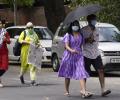
India is expected to experience hotter-than-usual temperatures from April to June, with more heatwave days in central and eastern India and the northwestern plains, the IMD said. Most parts of the country will see higher-than-normal maximum temperatures, except for some areas in western and eastern India where the temperatures are expected to be normal. Minimum temperatures will also be above normal in most regions. The IMD has warned that landslides could occur in parts of Kerala and Karnataka in the Western Ghats and that northeastern states might face flooding in April.

In Rajasthan, Pilani recorded 44.9 degrees Celsius, Phalodi and Churu touched 43.8 degrees Celsius and 43.5 degrees Celsius respectively, while Bikaner and Jaipur registered 43.4 degrees Celsius and 43 degrees Celsius.
Several global models are predicting El Nio to appear around the second half of the year, which are the crucial rain-bearing months.

Apart from the human body, human food will bear direct repercussions. From staples such as wheat, to coffee, dairy, and even the great Hilsa face the threat of reduced supply due to the extreme heat.

The conditions that lead to landslides, including soil texture, soil moisture and slope are known, and it is important to put all this knowledge into an operational system, he said.

Heatwave may abate over most parts of North India in next two days; temperatures likely to drop by 2-3C.
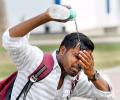
Heatwaves claimed more than 17,000 lives in 50 years in India, according to a paper authored by M Rajeevan, former secretary of Ministry of Earth Sciences, along with scientists Kamaljit Ray, S S Ray, R K Giri and A P Dimri.

Dubai was battered by Nature's fury on Monday, February 12, 2024.

India is likely to see above-normal rainfall in the four-month monsoon season (June to September) with cumulative rainfall rainfall estimated at 106 percent of the long-period average (87 cm), he said.

States are mandated to develop and implement 'heat HAPs' for prevention of heat-induced diseases. But most do not go beyond standard advisory on heat prevention.

As weather patterns grow more unpredictable due to climate crisis, India is taking a giant leap with "Mission Mausam" to improve weather understanding and forecasting through expanded observation networks, better modeling and advanced tools like AI and machine learning.

The threshold for a heat wave is met when the maximum temperature of a weather station reaches at least 40 degrees Celsius in the plains, 37 degrees in coastal areas, and 30 degrees in hilly regions, and the departure from normal is at least 4.5 notches.

There is a definite attempt to put the landslides on the backburner because news of them and climate change worry Wayanad's tourism and real estate businesses greatly. Whatever I experienced of Wayanad's 2024 by-elections; the July landslides were not a burning issue, observes Shyam G Menon.

Kerala Chief Minister Pinarayi Vijayan on Wednesday termed as 'baseless', Union Home Minister Amit Shah's claim that the state government did not heed the Centre's warning regarding a possible natural calamity in Wayanad due to heavy rains.

Some India states are likely to record a significantly higher number of heatwave days, according to the national weather body.

The IMD said that rainfall over India in August and September would be around 106 percent of the long-period average of 422.8 mm.

The warmest six years have all been since 2015, with 2016, 2019 and 2020 being the top three. The differences in average global temperatures among the three warmest years are indistinguishably small. The average global temperature in 2020 was about 14.9C, 1.2 ( 0.1) C above the pre-industrial (1850-1900) level.

The mercury soared to 46.2 degrees Celsius at Najafgarh, making it the hottest place in the capital.

'Nobody asked us to work on this. It was on our own that we decided to embark on this journey.'

'We will have to face the effects of climate change for generations to come!'

The heat wave is likely to impact parts of Jammu and Kashmir, Himachal Pradesh, Uttarakhand, Punjab, Haryana, Delhi, Rajasthan, Madhya Pradesh, Jharkhand, Odisha and Gangetic West Bengal, the Met office said.

Moody's Ratings on Tuesday said India's growing water shortage can disrupt farm and industry sectors and is detrimental to the credit health of the sovereign as rising food inflation and decline in income may spark social unrest. It said decreases in water supply can disrupt agricultural production and industrial operations, resulting in inflation in food prices and hence can be detrimental to credit health of sectors that heavily consume water, such as coal power generators and steel-makers.

Over the 10 years from 2001 to 2010, global temperatures have averaged 0.46 C (0.82 F) above the 1961-1990 average.

The Mungeshpur weather station recorded a high of 48.8 degrees Celsius, eight notches above the normal. It recorded a minimum temperature of 27.6 degrees Celsius, a notch above the season's average.

Temperatures in 17 locations breached 45 degrees Celsius on Monday, with the punishing heat affecting health and livelihoods.

Cyclone 'Biparjoy', the first storm brewing in the Arabian Sea this year, has rapidly intensified into a severe cyclonic storm, with meteorologists predicting a 'mild' monsoon onset over Kerala and 'weak' progress beyond southern peninsular under its influence.

Gaps in enforcement, limited monitoring, and easy access to firecrackers from the NCR region where restrictions were slack were largely responsible for the widespread flouting of the cracker ban in Delhi on Diwali, experts have opined.

Seven out of eight women street vendors reported experiencing high blood pressure, while women in the middle age group raised concerns about delays in their menstrual cycles due to the extreme heat.

The unrelenting heatwave sweeping large parts of the country has claimed at least 110 lives and left over 40,000 people grappling with suspected heatstroke between March 1 and June 18 this year, health ministry sources said on Thursday.

Surface temperatures have increased rapidly during the past century, leading to an increase in the frequency and intensity of tropical storms in the Arabian Sea, reports Sanjeeb Mukherjee.

The India meteorological department has issued a yellow alert, warning of a fresh heatwave spell in Delhi which may see temperatures soaring to 44 degrees Celsius by Wednesday.

India will launch its own composite index next year to quantify the impact of heat on its population and generate impact-based heat wave alerts for specific locations, the India Meteorological Department (IMD) has said.
